
The Permission Slip You’ve Been Waiting For
The Raising Hope Podcast · Episode 10 · Season 1 Finale
The Permission Slip You've Been Waiting For
by Kristy Giarratano
I've been thinking about what I wanted to say in this episode for a long time. Longer than I've been making this podcast, honestly.
Because the thing I want to say is something I needed someone to say to me. And nobody did. And I wasted a lot of years waiting for it.
So here it is — the season finale of Raising Hope — and I'm going to say it directly to you.
"You don't need to earn the right to want something different. You don't need to suffer enough, sacrifice enough, or explain yourself enough. You just need to decide."
The Thing Nobody Tells You About Being "Successful"
We spend so much of our lives chasing the version of success that was handed to us. The title. The salary. The family. The house. The calendar packed with things that matter — or at least, things that are supposed to matter.
And then one day — maybe it's a random Tuesday, maybe it's a milestone birthday, maybe it's a quiet moment when everyone else is asleep — you look at all of it and feel... nothing. Or worse, you feel that low hum. That hollow ache. That question you can't quite name.
And the cruelest part? You feel guilty for feeling it. Because look at your life. Look at everything you have. Who are you to want more? Who are you to want different?
That guilt is the thing that keeps high-achieving women stuck longer than anything else. Not lack of opportunity. Not lack of ability. The guilt of wanting.
What This Season Has Really Been About
We started this season talking about identity — who you are outside of what you do and who you take care of. We went deep into the mom layer, the way motherhood reshapes you in ways nobody prepares you for. We talked about courage and fear, about money, about joy. About what it actually looks like to build a life that fits the woman you've become — not the woman you were told to be.
Every single episode has been building to this one.
Because all of that — the identity work, the courage work, the grief of letting go of who you used to be — it only matters if you actually do something with it. If you actually give yourself permission to move.
"Permission isn't something anyone else can give you. It never was. The women who change their lives don't wait for it — they write their own slip and hand it to themselves."
You're Not Starting Over. You're Starting From Here.
I want to address something I hear from women constantly. The idea that it's too late. That they've already invested too much in the path they're on. That starting something new at this point in their life means admitting all those years were a mistake.
They weren't a mistake. They were the training ground.
Every year you spent in a career that no longer fits you? You built skills. Every year you poured yourself into other people? You built capacity. Every hard thing you navigated? You built resilience you don't even fully see yet.
You are not starting over. You are starting from the most equipped, most self-aware, most clear-eyed place you have ever been. That's not a disadvantage. That's everything.
So What's the Actual Next Move?
That's the question I get asked more than any other. And I love it — because it means the wanting is there. The readiness is there. The only thing missing is clarity on direction.
That's exactly why I created the Next Move Blueprint™ Session.
It's a 45-minute personalized session where we look at your natal chart and Human Design together to map out what you're actually built for — what lights you up, what drives your income, and what your next move looks like based on who you are at your core. Not a generic quiz. Not a template. A real, tailored blueprint for you.
Ready to Map Your Next Move?
The Next Move Blueprint™ Session is a 45-minute personalized natal chart + Human Design reading built around your next chapter. Walk away with real clarity — not more confusion.
Book Your Session →Not Sure Where to Even Start? I've Got You.
If you're at the very beginning — if you're still in the "I don't even know who I am anymore" phase — I want to give you something to start with right now.
The "Who the F*ck Am I Now?" workbook is free, it's real, and it's exactly what it sounds like. It's the first step. The place where you start getting honest with yourself about what you want, what you've outgrown, and who you're becoming.
Grab it. Do it. Come back and tell me what came up for you.
Grab the Free Workbook
"Who the F*ck Am I Now?" — the starting point for every woman who knows something needs to change but can't quite name it yet. Free. No fluff. Just the real work.
Get the Free Workbook →One More Thing — Don't Miss the Giveaway
Next week I'm running a giveaway on Instagram and Facebook for a free Next Move Blueprint™ Session — a $197 value, yours for free. If you've been curious about what your chart and Human Design say about your next chapter, this is your moment.
Follow me on both platforms so you don't miss it when it drops. All the details will be there first.
Win a Free Next Move Blueprint™ Session
A $197 personalized natal chart + Human Design session — yours free. Follow me on Instagram and Facebook so you don't miss it.
Thank You for This Season
I started this podcast because I needed it to exist. Because I was the woman sitting in the parking lot, badge in hand, running out of time to keep pretending I was fine. And I didn't have anyone handing me a permission slip.
So I'm handing it to you.
You're allowed to want more. You're allowed to want different. You're allowed to take up space in a life that actually fits you. You don't need to justify it, earn it, or explain it to anyone.
Write your own permission slip. Sign it. And let's figure out your next move together.
I'll see you in Season 2.
— Kristy
I've been thinking about what I wanted to say in this episode for a long time. Longer than I've been making this podcast, honestly. Because the thing I want to say is something I needed someone to say to me. And nobody did. And I wasted a lot of years waiting for it.
So here it is — the season finale of Raising Hope — and I'm going to say it directly to you.
"You don't need to earn the right to want something different. You don't need to suffer enough, sacrifice enough, or explain yourself enough. You just need to decide."
The Thing Nobody Tells You About Being "Successful"
We spend so much of our lives chasing the version of success that was handed to us. The title. The salary. The family. The house. The calendar packed with things that matter — or at least, things that are supposed to matter.
And then one day — maybe it's a random Tuesday, maybe it's a milestone birthday, maybe it's a quiet moment when everyone else is asleep — you look at all of it and feel... nothing. Or worse, you feel that low hum. That hollow ache. That question you can't quite name.
And the cruelest part? You feel guilty for feeling it. Because look at your life. Look at everything you have. Who are you to want more? Who are you to want different?
That guilt is the thing that keeps high-achieving women stuck longer than anything else. Not lack of opportunity. Not lack of ability. The guilt of wanting.
What This Season Has Really Been About
We started this season talking about identity — who you areoutside of what you do and who you take care of. We went deep into the mom layer, the way motherhood reshapes you in ways nobody prepares you for. We talked about courage and fear, about money, about joy. About what it actually looks like to build a life that fits the woman you've become — not the woman you were told to be.
Every single episode has been building to this one. Because all of that — the identity work, the courage work, the grief of letting go of who you used to be — it only matters if you actually do something with it. If you actually give yourself permission to move.
"Permission isn't something anyone else can give you. It never was. The women who change their lives don't wait for it — they write their own slip and hand it to themselves."
You're Not Starting Over. You're Starting From Here.
I want to address something I hear from women constantly. Then idea that it's too late. That they've already invested too much in the path they're on. That starting something new at this point in their life means admitting all those years were a mistake.
They weren't a mistake. They were the training ground.
Every year you spent in a career that no longer fits you? You built skills. Every year you poured yourself into other people? You built capacity. Every hard thing you navigated? You built resilience you don't even fully see yet.
You are not starting over. You are starting from the most equipped, most self-aware, most clear-eyed place you have ever been. That's not a disadvantage. That's everything.
So What's the Actual Next Move?
That's the question I get asked more than any other. And I love it — because it means the wanting is there. The readiness is there. The only thing missing is clarity on direction. That's exactly why I created the Next Move Blueprint™ Session. It's a 45-minute personalized session where we look at your natal chart and Human Design together to map out what you're actually built for — what lights you up, what drives your income, and what your next move looks like based on who you are at your core. Not a generic quiz. Not a template. A real, tailored blueprint for you.
Ready to Map Your Next Move?
The Next Move Blueprint™ Session is a 45-minute personalized
natal chart + Human Design reading built around your nextchapter. Walk away with real clarity — not more confusion.
Book Your Session →
Not Sure Where to Even Start? I've Got You.
If you're at the very beginning — if you're still in the "I don't even know who I am anymore" phase — I want to give you something to start with right now.
The "Who the F*ck Am I Now?" workbook is free, it's real, and it's exactly what it sounds like. It's the first step. The place where you start getting honest with yourself about what you want, what you've outgrown, and who you're becoming.
Grab it. Do it. Come back and tell me what came up for you.
Grab the Free Workbook
"Who the F*ck Am I Now?" — the starting point for every woman
who knows something needs to change but can't quite name it
yet. Free. No fluff. Just the real work.
Get the Free Workbook →
One More Thing — Don't Miss the Giveaway
Next week I'm running a giveaway on Instagram and Facebook for a
free Next Move Blueprint™ Session free Next Move Blueprint™ Session free Next Move Blueprint™ Session free Next Move Blueprint™ Session — a $197 value, yours for free.
If you've been curious about what your chart and Human Design say
about your next chapter, this is your moment.
Follow me on both platforms so you don't miss it when it drops. All
the details will be there first.
G I V E AWAY S TA R T I N G N E X T W E E K
Win a Free Next Move Blueprint™
Session
A $197 personalized natal chart + Human Design session — yours
free. Follow me on Instagram and Facebook so you don't miss it.
Follow on Instagram Follow on Facebook
!ank You for !is SeasonI started this podcast because I needed it to exist. Because I was
the woman sitting in the parking lot, badge in hand, running out of
time to keep pretending I was fine. And I didn't have anyone handing
me a permission slip.
So I'm handing it to you.
You're allowed to want more. You're allowed to want different. You're
allowed to take up space in a life that actually fits you. You don't
need to justify it, earn it, or explain it to anyone.
Write your own permission slip. Sign it. And let's figure out your next
move together.
I'll see you in Season 2.
— Kristy
The Mom Layer: The Part Nobody Talks About
A companion post to Episode 6 of the Raising Hope Podcast
There’s a conversation that happens a lot in women’s spaces about burnout, reinvention, and wanting more out of life. And most of the time, it’s a good conversation. But there’s a layer that almost never gets talked about.
The mom layer.
Not the “being a mom is hard” conversation — we’ve all heard that one. I mean the specific, complicated, sometimes gutting experience of being a high-achieving woman who became a mother and somewhere along the way stopped being able to find herself underneath all of it. That’s what this episode is about. And that’s what this post is about. Because if you’re here, I don’t think you just want a pep talk. I think you want someone to actually name what’s happening.
So let’s name it.
Motherhood Didn’t Break You. It Buried You.
When you became a mom, something shifted. Not just logistically — though yes, everything changed logistically. Something shifted in how you saw yourself. Suddenly there was this other person whose needs were louder than yours. Whose schedule came first. Whose wellbeing you would do literally anything to protect. And you did it — you showed up for that. You were made for it in a lot of ways. But here’s what nobody told you: every time you pushed your needs to the back of the line, you were also teaching yourself that your needs didn’t matter as much. Not intentionally. Not dramatically. Just quietly, steadily, over time.
And then one day you looked up and realized you couldn’t actually tell what you wanted anymore. Not in a small way. In a big, unsettling way.What do I actually like? What do I want my life to look like — not for them, for me? Who am I when I’m not someone’s mom, someone’s employee, someone’s everything?
That’s the burial. Not one big moment. A thousand small ones.
The Guilt That Keeps You Stuck
Here’s the part that really gets me. Because I’ve lived this. When you start to feel the emptiness — when you start to think, “I want more than this,” or “something needs to change” — the very next thought for most moms is guilt.
What kind of mother wants more? I have everything. My kids need me. Who am I to feel unfulfilled?
And that guilt is not random. It’s trained. We are handed a story from the time we’re little girls that a good mother is a selfless mother. That wanting things for yourself means you’re taking something away from your kids.
It’s not true. But it feels true. And when something feels true, it acts like truth. So you suppress the wanting. You push it down. You tell yourself to be grateful. And you keep performing the version of yourself that everyone else needs — capable, steady, fine.
But you’re not fine.
And the wanting doesn’t go away.
It just goes underground.
And underground wants get heavy.
What It’s Actually Like to Be a Single Mom in the Middle of Reinvention
I want to get personal here for a second, because I think it matters. I am a single mom. My daughter’s middle name is Hope — and she is the reason behind this entire brand, this podcast, all of it. When I started thinking about leaving nursing and building something new, I didn’t have a partner to split the mental load with. I didn’t have a backup plan that included someone else’s income. Every decision I made had a direct impact on her — her stability,
her security, her life.
Do you know what it’s like to want something badly and also be terrified that wanting it makes you a bad mom?
That’s a specific kind of weight. And it doesn’t get talked about enough. Because here’s what the reinvention content almost never accounts for: when you’re a single mom, the stakes feel different. The risk feels more personal. You don’t get to just “bet on yourself” — you’re betting on both of you.
And yet.
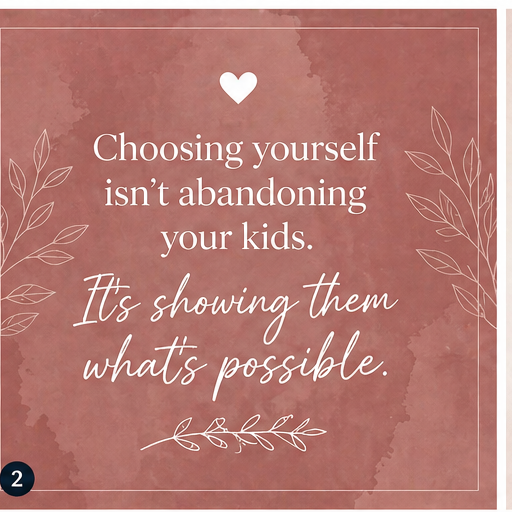
Staying stuck wasn’t protecting her either. Staying in something that was slowly hollowing me out wasn’t modeling anything I wanted her to grow up watching. The most powerful thing I ever did for my daughter was decide that her mom was going to be a woman who actually lived her life. Not perfectly. Not without fear. But actually,
honestly lived it. That’s the part nobody talks about. That choosing yourself isn’t abandoning your kids.
It’s showing them what’s possible.
The Identity Shift Nobody Prepares You For
Here’s what I’ve come to understand, both personally and through the work I do with women:
Motherhood is one of the most significant identity shifts a person can go through. Full stop.
It rewires your brain. It changes your priorities. It makes you capable of love that you didn’t know existed. All of that is real and beautiful.
But it also — if you’re not careful — can quietly erase the person you were building before the kids came. The ambitions. The dreams. The version of you that was going somewhere.
And what makes it so tricky for high-achieving women specifically is this: you didn’t stop being ambitious. You just turned all of it toward your family and your job and everyone else’s needs. You are still working incredibly hard. You are still producing. You are still performing at a high level.
But you stopped performing for yourself.
And that gap — between how capable you are and how alive you feel — that’s where the
quiet desperation lives.
You Are Not Behind. You Are Buried.
I want to say this clearly, because I mean it:
You are not a woman who has fallen behind. You are not someone who missed her window. You are not broken or difficult or ungrateful.
You are a high-achieving woman who has been carrying an enormous amount — for a long time — with very little space to ask what you actually need.
That’s not weakness. That’s the result of a culture that tells moms to be everything to everyone and forget to be anything to themselves.
And the fact that you’re here — that something in you is still asking the question — that’s not a problem. That’s hope.
That’s your life, still knocking.
What Comes Next
If this resonated with you — if you heard yourself somewhere in these words — I want you to know that the path forward doesn’t start with a big dramatic leap.
It starts with honesty. With allowing yourself to acknowledge what’s true without immediately talking yourself out of it. You wanted something. You still want it. That’s allowed.
And there is a version of your life where you are a great mom AND a woman who is fully, unapologetically alive. Those are not opposites. They never were.
Listen to Episode 6 of the Raising Hope Podcast wherever you get your podcasts.
If you’re ready to figure out what your next move actually looks like — not in theory, but for you specifically — the Next Move Blueprint™ Session is the place to start. In 45 minutes, we use your natal chart and Human Design to map out what you’re built for and what step to take next.
Because you don’t need more motivation. You need clarity.
Raising Hope is a podcast for high-achieving women who are done performing and ready to actually live.
New episodes drop weekly.
Joy as a Practice: What Your Life Actually FeelsLike When You Stop White-Knuckling It
You know what I did this morning?
I sat on my back porch with my coffee. I didn’t check my phone. I didn’t think about my to-do list. I didn’t feel that familiar knot of dread in my stomach. I just sat there. Watched the birds. Felt the sun on my face. And I thought: this is it. This is what I was looking for. Not a six-figure business. Not Instagram success. Not some picture-perfect life that looks good on paper.
Just… peace.
If you’ve been listening to the Raising Hope podcast, you’ve heard me talk about why you’re stuck. What’s keeping you there. How to move. But I haven’t really talked about what you’re actually moving toward.
And that matters. Because reinvention isn’t about becoming someone else. It’s about getting your life back.
Let me show you what that looks like.
The Joy Everyone Forgot to Tell You About
When people talk about leaving a career, changing your life, making a big move — they usually talk about the fear. The risk. The uncertainty.
What they don’t talk about is what comes after.
What your life actually feels like.
And that’s the conversation we need to have.
Because here’s what I want to be really clear about: when I talk about joy, I’m not talking
about being happy all the time. I’m not talking about toxic positivity or finding the silver
lining in everything.
I’m talking about something much more fundamental.
I’m talking about the absence of dread.
For 15 years, I woke up with a knot in my stomach. Sunday nights were filled with existential terror. I had energy for my job, my staff, my responsibilities — but nothing left for myself, my daughter, my relationships.
My nervous system was in constant crisis mode.
I didn’t even realize how much that cost me until it was gone.
When I finally left nursing and started building something that actually aligned with who I am, something shifted. Not overnight. But gradually, my nervous system started to settle.
The dread disappeared.
The Sunday night panic stopped.
I woke up and my first feeling wasn’t terror.
That’s what I mean by joy. Not constant happiness. Not pretending everything is perfect.
But peace. Space. The ability to breathe.
What Actually Changes When You Stop Running on Empty
Let me paint you a picture of what your life can actually feel like.
Your mornings become yours.
I wake up — no alarm if I don’t want one — and I have time to think before I have to be “on” for anyone. I have coffee. I journal. I might sit on the porch. Nobody’s asking me for anything yet. Nobody’s depending on me to be functional right this second.
That sounds small. But when you’ve spent years rushing out the door at 5:30am, when you’ve been running on fumes, when you’ve been operating from constant obligation — having a peaceful morning is everything.
You get to say no without explaining.
Someone asks me to do something and I can just say: no, that doesn’t work for me. I don’t owe them a paragraph of reasons. I don’t have to earn the right to say no. I don’t have to perform being available.
This sounds simple. But it’s revolutionary.
Your relationships actually improve.
When you’re running on empty, you have nothing left to give the people you love. Your partner gets the exhausted version of you. Your kids get leftovers. Your friendships are on autopilot.
But once you have energy again? Once you’re not depleted? Everything changes.
I’m more present with my daughter now than I ever was when I was working 60 hours a week. I can actually listen. I can show up. I can just be her mom without it being one more thing I’m squeezing into an impossible schedule.
My friendships are deeper because I’m actually present. I have something to give.
Your work starts to matter.
You’re not just managing. You’re not just surviving until the weekend or retirement.
You’re doing work that actually aligns with who you are. Work that uses your real gifts.
Work that makes you feel alive instead of drained.
Every single day, I get to do work that matters to me. Work I believe in. Work that’s connected to my actual values and abilities.
That’s not something I took for granted before.
You have time to actually take care of yourself.
Rest doesn’t feel like laziness. Movement doesn’t feel like punishment. Taking care of yourself doesn’t feel guilty.
Because you’re not operating from a place of depletion anymore. Self-care isn’t something you have to squeeze in. It’s something that’s naturally part of your life because you have space for it.
Your intuition comes back.
When you’re in survival mode, you can’t hear anything except the noise in your own
head. The anxiety. The fear. The pressure.
But once your nervous system settles, you can actually listen. To yourself. To your gut.
To what the universe is trying to tell you.
That clarity is transformative.
The Thing Nobody Warns You About: Understanding Your Design
Here’s something that changed my life that I didn’t expect.
I started understanding myself on a much deeper level.
Not just intellectually — “I think I like this” — but on a soul level. What I’m actually built for. How my nervous system works. What makes me come alive.
I looked at my Human Design chart. I pulled my astrology. And suddenly everything made sense.
I’m not just someone who wants to do deep transformative work with women. My chart shows me I’m designed for it. My Human Design tells me this. My astrology confirms it.
It’s all pointing to the same thing.
And once you know that — once you have language for why you’re wired the way you
are, what you’re built for, what will make you actually thrive — everything clicks into place.
You stop swimming upstream.
You stop trying to force yourself into a mold that was never meant to hold you.
You start moving in the direction your whole being is pulling you toward.
And that’s where real, sustainable joy lives. Not in achieving something external. But in aligning your life with who you actually are.
The Honest Part: It’s Not Perfect
I want to be really real about something.
Joy as a practice doesn’t mean everything is perfect. It doesn’t mean I wake up every day feeling amazing. It doesn’t mean the work is easy or that I don’t struggle.
I still have hard days. I still have moments of doubt. I still sometimes think: did I make a huge mistake?
The difference is: those days are just days now. They’re not my whole life.
When I was in nursing, the hard days were constant. The doubt was chronic. The feeling that something was wrong with me was never-ending.
Now? The hard days come and go. They’re moments, not my baseline.
I still have to show up for work even when I don’t feel like it. I still have hardconversations. I still deal with things that aren’t fun.
But I’m doing it from a place of choice. Not obligation. Not desperation. Not because I have to prove something.
From choice.
And that changes everything.
How You Actually Get Here
You’re reading this and thinking: that sounds amazing. But how do I actually get there?
Here’s the truth: you get there through the same path I walked you through in Episode 4
You get there by doing the hard work of:
Stabilizing — getting grounded enough to think clearly
Observing — understanding what you actually want
Designing — building something that actually fits you
Executing — taking action even when you’re scared
You get there one small move at a time.
But here’s what I also want you to know: you don’t have to figure it out alone.
When I work with women, we do deep work together. We look at what’s actually
stopping them. We help them understand what they’re built for — not just intellectually,
but on a soul level.
And part of that work includes looking at your Human Design and your astrology.
Understanding not just “what do I want?” but “what am I actually designed to do? What
will make me come alive?”
Because once you know that, the path becomes so much clearer.
It’s not just “I want to leave my job.” It’s “I’m built for deep transformative work, and this
job isn’t the vehicle for that, so here’s what is.”
It’s not just “I want to be happy.” It’s “This is how I’m wired, this is what makes me come
alive, so let’s build a life around that.”
That clarity changes everything.
Your Actual Next Step
If you’ve been reading this and something in you is saying: okay, I’m ready. I’m ready to feel what she’s talking about. I’m ready to get my life back — then let’s do this.
The first step is free.
Take the Raising Hope Quiz. It takes five minutes. It will tell you exactly where you are in your reinvention — which stage, what you need to focus on, what your path looks like.
If that lands for you, if something shifts, the next step is applying to work together. My coaching applicationis also free. It’s just a conversation starter. You fill it out, we talk, and we figure out if working together is right for you.
And if it is? We do the real work. We map out where you are.
We figure out what you’re built for. We create a plan. And we walk through it together. Part of what you get when we work together is your personalized Human Design and astrology map. So you actually understand what you’re designed for. What will light you up. How to honor your own wiring in the life you’re building.
Because that’s where real joy lives. In alignment. In knowing yourself. In building a life that actually fits.
This Life Is Waiting for You
This life you want? The one where you’re not white-knuckling? Where you have space
and energy and peace?
It’s not a fantasy.
It’s not something that only happens to other people.
It’s waiting for you.
You just have to be willing to build it.
And if you want the full story — the real, vulnerable, honest conversation about what it
feels like to move from survival mode to actually living your life — listen to Episode 5 of the Raising Hope podcast.
I’m not holding back on that one.
Your porch with your coffee is waiting.
Ready to take the first step?
Take the free Raising Hope Quiz to see where you are in your reinvention journey.
Apply to work with me if you’re ready for real support moving from knowing to doing.
Orlisten to Episode 5 of the podcast to hear the full story.
Either way, I’m here. And I believe in you.
Raising Hope is about helping women move from stuck to alive. From performing to
being. From white-knuckling their way through life to actually living it. If this resonated,
share it with a woman who needs to hear it.

You Don't Have to Keep PretendingYou're Fine
You have the career. The title. The resume that makes other people say, "Wow, you've really done it."
And still — quietly, privately — you stay awake wondering if this is really it. If this is what all that sacrifice was for.
You're not ungrateful. You're not lazy. You're not having a breakdown.
You're just done.
Done performing a version of yourself that doesn't fit anymore.
Done pouring everything into a life that looks right on the outside but feels hollow on the inside.
I see you. Because I was you.
Who I Work With
I work with high-achieving women — a lot of them mothers — who have spent years doing
everything right and somehow still ended up lost.
Maybe you're a nurse who's given everything to her patients and has nothing left for
herself. Maybe you're a leader who's climbed every ladder put in front of her and just
realized she's on the wrong building. Maybe you're a mom who loves her kids fiercely and
still quietly grieves the woman she used to be — or the woman she never got to become.
You're successful by every external measure. But inside? You're exhausted.
Disconnected. Secretly wondering if wanting more makes you selfish.
It doesn't. It makes you human.
How I Help
I don't hand you a five-step plan and send you on your way. That's not coaching — that's a
checklist.
What I do is sit with you in the hard middle part — the part where you know something has
to change but you can't yet see what's on the other side — and I help you find your way
through it.
Using my H.O.P.E. Method™, we move together through four stages: holding steady
when everything feels uncertain, getting clear on who you actually are beneath all the
roles you play, designing a life that finally reflects your values, and moving forward with
intention instead of fear.
This is deep, real work. It will challenge you. It will also free you.
What's Possible
Women I've worked with have left careers that were slowly killing them — and found ones
that light them up. They've stopped shrinking in rooms where they used to disappear.
They've looked at their daughters and thought, I'm showing her what it looks like to choose yourself.
That's not magic.
That's what happens when you stop white-knuckling through your life and start actually living it.
You Don't Have to Figure This Out Alone
If any of this landed somewhere real in your chest — that's worth paying attention to.
I offer 1:1 private coaching for women who are ready to do the work. I also offer a VIP
Intensive Day if you need to move fast and go deep. And if you want community alongside
the growth, Becoming Her — my group program — is currently accepting waitlist interest.
Not sure where you are in your reinvention? Take the free quiz at kristygiarratano.com and
find out. It takes five minutes and will tell you exactly what stage of transition you're in —
and what you need most right now.
You've spent long enough being successful at the wrong life.
Let's build the right one.
You’re Not Stuck Because You’re Lazy. You’re Stuck Because You’re Smart.
The real reason high-achieving women don’t make the leap — and what fear looks like when it wears a suit.
You’ve thought about it a hundred times.
Leaving. Pivoting. Starting over. Doing the thing that actually lights you up instead of the
thing you’ve always done. And every time you get close to taking a real step forward, a
very reasonable, very logical voice shows up in your head.
The timing isn’t right.
I need to be more financially stable first.
My kids are too young right now.
I don’t have enough experience in that area yet.
Once [X] happens, then I’ll make the move.
These sound like practical considerations. They sound like responsible thinking. They
sound like exactly the kind of careful, measured reasoning that made you successful in
the first place.
Here’s what I want you to consider: What if they’re not?
What if that voice — the one that always has a really good reason to wait — isn’t
wisdom?
What if it’s fear?
Fear Doesn’t Look Like Fear Anymore
When we imagine fear, we imagine panic. Paralysis. The inability to function.
But that’s not how fear operates in high-achieving women. You’re too capable for that
kind of fear. You’ve spent decades training yourself to push through discomfort, tofunction under pressure, to not let your feelings get in the way of your performance.
So fear adapted. It got smarter.
In high-achievers, fear doesn’t show up as panic. It shows up as planning. As research.
As “I just need a little more time.” As an ever-growing list of prerequisites that must be
met before the real work can begin.
Fear in a high-achieving woman looks exactly like competence. And that’s what makes it
so hard to catch.
The Reasons Are Real. That’s What Makes Them Dangerous.
Let me be clear: I’m not saying your practical concerns aren’t valid. The money is real.
The timing is real. The kids are real. The risk is real.
But here’s the question worth sitting with:
Would those concerns stop you if you weren’t also afraid?
Because here’s the thing about the women I work with — they are resourceful, capable,
and have solved harder problems than this one. When they actually want something,
they figure it out. They make it work. They find the time, the money, the plan.
The practical concerns only become insurmountable when fear is quietly working behind
them, making them feel bigger than they are.
The timing will never be perfect. The finances will never feel completely secure. Your
kids will always need something. If those were the only factors, you’d have figured it out
already.
What’s actually keeping you stuck isn’t the circumstances. It’s what you’re afraid will
happen if you try.
So What Are You Actually Afraid Of?
Let’s name some of them, because naming fear takes away a little of its power:
Fear of failure. What if you make the leap and it doesn’t work? What if you leave the
career you spent twenty years building and the new thing falls apart? What if you were
wrong about what you wanted?
Fear of success. This one is sneaky. What if it does work — and then everything
changes? What if success in this new direction means disappointing people, outgrowing
relationships, becoming someone your current circle doesn’t recognize?
Fear of being seen. Staying stuck is safe. Nobody can judge a woman for not trying.
But putting yourself out there — writing, speaking, coaching, creating, leading in a new
way — makes you visible. And visibility feels dangerous when you’ve been performing
for so long.
Fear of the gap. The space between where you are and where you want to be feels
enormous. And in that gap, your brain generates worst-case scenarios like it’s being
paid to.
Fear that you don’t deserve it. That you’re not smart enough, young enough,
credentialed enough, ready enough to be the person who gets to do something
different. That wanting more is somehow greedy when you already have so much.
None of these fears are irrational. But none of them are facts, either.
Waiting Is Also a Choice
This is the part nobody wants to hear: staying exactly where you are is not a neutral act.
It’s a decision. And it has consequences.
Every year you wait, you get more entrenched. The routine gets harder to break. The
identity you’ve built around your current life gets heavier. The gap between who you are
and who you want to be gets wider and starts to feel less like possibility and more like
loss.
I’m not saying this to scare you. I’m saying it because you deserve honesty.
You are not waiting for the right moment. You are protecting yourself from the
risk of being wrong.
And I get it. Deeply. I lived this. I know what it’s like to have a very good reason to stay put and a very quiet knowing that you can’t.
The question isn’t whether you’ll ever feel completely ready. You won’t. Nobody does.
The question is: how much longer are you willing to let fear make this decision for you?
The Move Forward Doesn’t Have to Be a Leap
Here’s the good news: I’m not asking you to blow up your life tomorrow. I’m not telling
you to quit your job on Monday or burn anything down.
The antidote to fear-driven stuckness isn’t reckless action. It’s intentional movement.
Small, real steps that start to break the pattern — that show your nervous system that
motion is survivable. That you can take a step without everything falling apart.
The first step isn’t the biggest one. It’s just the next one.
And you don’t have to figure out what that is alone.
If this hit close to home, the Raising Hope quiz is a good place to start. It’ll tell you
exactly where you are in your reinvention journey and give you a personalized next step.
Take it at [kristygiarratano.com].
And if you’re ready to stop waiting and start moving — with support — the coaching
application is open. I work with a small number of women at a time, and I’d love to see if
we’re a fit.
Listen to the full conversation on the Raising Hope Podcast, Episode 3: “It’s Not What You Think.”

Who Are You When No One’s Watching?
Why high-achieving moms lose themselves — and what it actually means
Let me ask you something. And I want you to actually sit with it before you answer.
Who are you?
Not what you do. Not your job title. Not “mom.” Not the degrees on your wall or the
licenses you’ve earned or the thing you say at parties when someone asks. Not the role.
Not the resume.
Who are you?
If your mind just went blank — or the first thing that came up was something you do
rather than something you are — you’re not broken. You’re not failing. You’re one of
millions of high-achieving women who built an incredible life and quietly lost themselves
somewhere along the way.
And it makes complete sense that it happened.
You Were Taught to Perform, Not to Know Yourself
Here’s the thing nobody tells ambitious women: the same traits that make you excellent
at your career make you vulnerable to losing your identity.
You’re good at meeting expectations. You’re good at becoming what a situation
requires. You’re good at performing — at a high level, consistently, for a long time.
That’s not a flaw. It got you here.
But over years and decades, all that performing can quietly crowd out something more
essential: the knowledge of who you actually are underneath all of it.
You know what you’re supposed to want. You’re less sure what you actually want.
You know how to succeed. You’re not sure what your version of a good life even looks
like anymore.
Then Motherhood Happened — And Everything Shifted
There’s a concept in psychology called matrescence — the process of becoming a
mother. It’s as significant an identity shift as adolescence, but we don’t talk about it that
way. We talk about the logistics. The sleep deprivation. The childcare. We don’t talk
about the fact that becoming a mother fundamentally changes who you are.
And for high-achieving women, that shift hits differently.
Because you were already running at full capacity. You already had an identity built
around excellence, around being capable and competent and on top of things. And then
motherhood arrived and reshuffled the whole deck.
Suddenly the thing you were best at — performing, producing, achieving — didn’t map
cleanly onto this new role. You couldn’t optimize your way through a newborn. You
couldn’t hit metrics on love. You couldn’t perform your way into feeling like yourself.
And in the middle of that disorientation, most of us just… kept going. We added “mom”
to the identity stack and kept performing. Because that’s what we knew how to do.
What we didn’t realize was that the foundation underneath had shifted. And at some
point, you look up and realize: I don’t actually know who I am underneath all of these
roles.
“Having It All” Was Supposed to Feel Like More Than This
You did the thing. You built the career. You have the family. You show up. You contribute.
You achieve.
And it feels hollow.
If you’ve ever had that thought — the one that sounds like I should be grateful, so why
do I feel this empty — I want you to know something: that feeling is not ingratitude. It’s
not selfishness. It’s information.
It’s your actual self, signaling that something is off. That the life you’ve been performing
isn’t quite the life you actually want to be living.
The problem isn’t that you have too much. The problem is that somewhere along the
way, you stopped being a person and became a function.
A function that earns. A function that parents. A function that manages and produces
and shows up. But a function, not a person.And functions don’t have needs. They don’t have desires. They don’t wonder about their
purpose or mourn the unlived parts of themselves.
But you do.
Because you’re not a function. You’re a woman. And she’s still in there,
waiting.
This Isn’t About Finding Yourself. It’s About Remembering.
Here’s what I want to leave you with:
You don’t need to go discover some brand new self. She’s not lost — she’s buried. Under
the expectations and the roles and the years of being everything to everyone. Under the
performance.
The work isn’t reinvention from scratch. It’s excavation. It’s peeling back what doesn’t
belong to you and remembering what does.
And that work? It’s some of the most important you’ll ever do. Not because of what it
produces — but because of who it returns to you.
Yourself.
Ready to figure out where you are in your reinvention? Take the free Raising Hope quiz
at [kristygiarratano.com] — it’s five minutes and gives you a personalized result based
on your actual stage. Or if you’re ready to go deeper, the coaching application is currently
open.
Listen to the full conversation on the Raising Hope Podcast, Episode 2: “Who Are You When No One’s Watching?”
Losing Yourself After Becoming a Mom — You're Not Broken, You're Becoming
Feeling like a different person after becoming a mom? You're not alone.
Here's what losing yourself after motherhood really means — and what comes next.
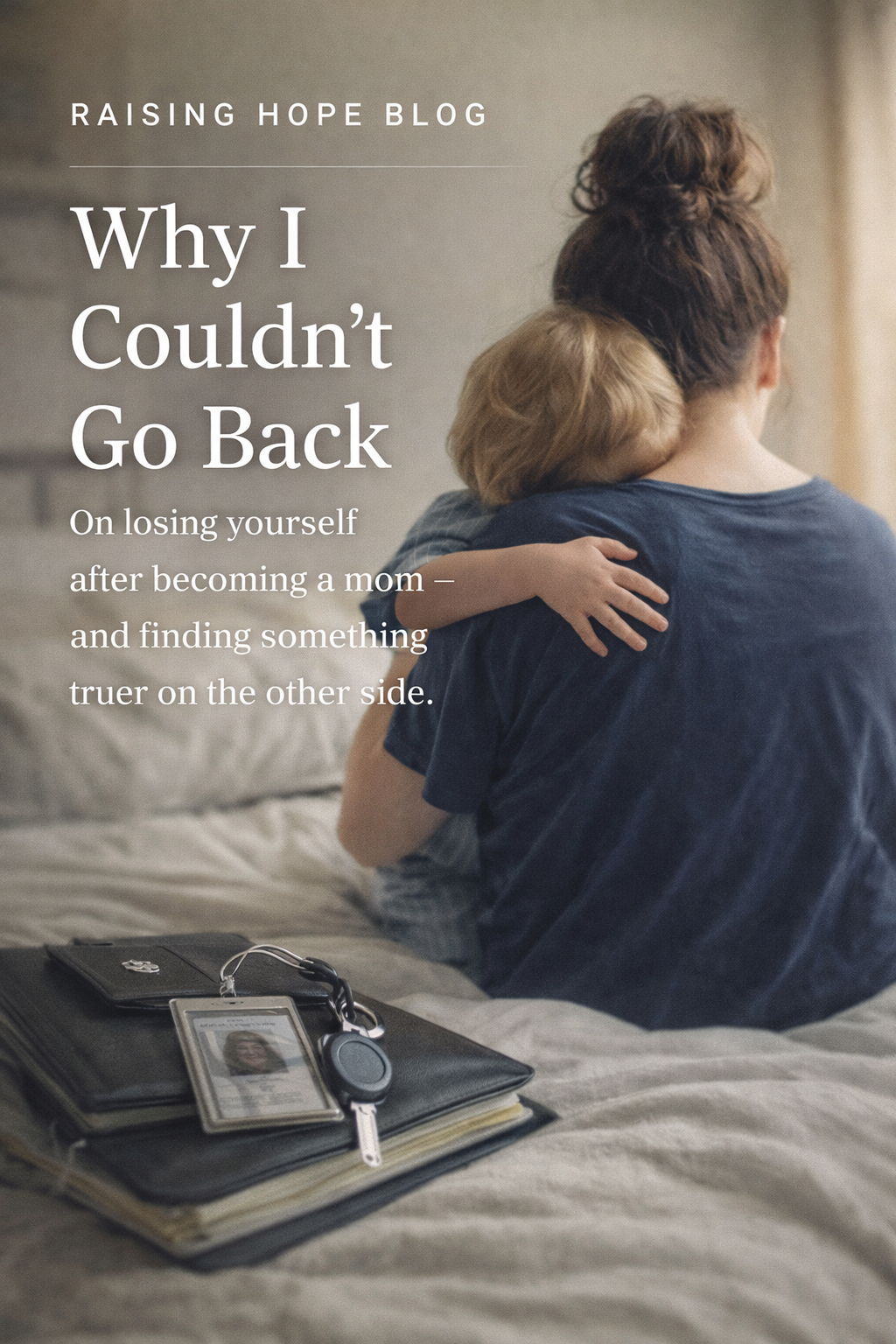
Why I Couldn't Go Back
On losing yourself after becoming a mom — and finding something truer on the
other side.
If you're losing yourself after becoming a mom, you're not weak. You're not ungrateful. And
you're definitely not alone. On the surface, I had it all figured out — director of an emergency
department, fifteen years of career behind me, the title, the respect, the paycheck. And then I
became a mother, and everything I thought I knew about myself shifted.
Nobody tells you that becoming a mother doesn't just add to your life — it rewires it
completely.
I spent thirteen cycles of IVF to get here. Thirteen. Each one a physical and emotional
marathon. When I finally held my daughter, I thought: this is what I worked for. This is what
matters.
Then, six months later, I had to go back to work.
When Losing Yourself After Motherhood Gets Heavy
What nobody saw was that I wasn't just a working mom. I was a single working mom. I didn't
have a choice but to work. There was no partner to fall back on, no second income, no one
else responsible for keeping my daughter fed and safe.
I was a working mom with untreated postpartum depression and severe anxiety. I was
navigating a family situation that felt unsafe and unsupportive — the exact opposite of what I
needed when I was most vulnerable. I was trying to rebuild my identity as a mother while still
performing competence as a leader. And I was running on fumes.Five or six months back at work, it hit. I was sitting in my car in the hospital parking lot, and I
couldn't make myself go in. Not because I was weak or ungrateful. But because something
inside me was screaming: this is not your life anymore. You don't want this anymore.
And underneath that scream was terror. How was I going to pay for formula? Special formula
— the kind my daughter needed. How was I going to pay for diapers, childcare, rent,
everything? The pressure was immeasurable. I was the only one she had. I couldn't afford to
break down.
Except I was breaking down. And I had to figure it out anyway.
What Nobody Tells High-Achieving Moms
Here's what I wish someone had told me: losing yourself is not a character flaw. It's not
weakness. It's what happens when you layer high achievement, motherhood, unprocessed
trauma, and a culture that expects you to do it all without breaking.
And the other thing nobody talks about? The fact that you can have postpartum depression
and be a successful professional. You can want your career and desperately want to be
home. You can love what you built and know in your bones that it's not enough anymore.
These things aren't contradictions. They're the real human experience.
That moment in the parking lot wasn't a breakdown. It was a breakthrough. It was the moment
I stopped asking 'how do I do this?' and started asking 'do I actually want to?'
And the answer was no.
Finding Yourself Again After Motherhood
From that moment, everything changed. I got into therapy. I got on medication. I made a plan.
I decided I wasn't going back to that toxic environment, and I wasn't going back to a life that
didn't fit anymore.
But here's the thing: I didn't figure this out alone, and you don't have to either.
If any of this resonates — if you're successful on paper but feeling hollow, if you became a
mother and realized everything shifted, if you're running on fumes and wondering if there's
another way — you're not alone.
And there is.
→Take the Raising Hope Reinvention Quiz to discover which stage of reinvention you're
actually in. Your results will show you exactly where you are and what you need next.
→Listen to Episode 1 of the Raising Hope Podcast — 'Why I'm Here (And Why I Think You
Are Too)' — where I tell this story in full, and we dig into what it really means to rebuild a life
that's actually yours.
→ Ready to go deeper? Schedule a free consultation to explore what coaching could look like
for you. Because the life you want isn't a fantasy. It's waiting on the other side of the decision
to claim it.
You don't have to stay stuck.
I promise you, there is a next chapter.